Thursday, July 5, 2012

Spain: Days 7&8

June 16-17, 2012
On Saturday we picked up a rental car and drove 600km to Malaga, Spain.  You can see Madrid with the * and Malaga is almost straight south on the Mediterranean Sea. On this map you can also see other places we visited on our trip.  These include Toledo, Cordoba, Ronda, Gilbraltar, Grenada and we even took the ferry over to Tangier, Morroco.


This was the rental car.  It was diesel and it got amazing gas mileage!


This picture was taken on our way to church.  I'm standing right outside of the timeshare - the Sea and beach is right behind me.  It was a 30 second walk to the beach.  Beside me are the beautiful gardens at the hotel. 


Can you tell that Warren did 99% of the picture taking??


On Sunday we found the local LDS church.  It was in a a residential neighborhood but there was a nice building and even a really small (10 people) English speaking branch.  The missionaries told us the Spanish  branch is growing rapidly.  When we were in Madrid, sitting at an outside table at a restaurant, we saw a pair of missionaries walking by.  We called them over to talk to them.   The one missionary said they were hesitant to come over as most people call them over to yell at them.  Spain is very catholic :) 


Later in the day, we drove the short distance to Marabella to walk on the boardwalk. 


Warren liked this car...alot.  I think it's a lamborghini or maybe a ferrari :)

People were flocked around this Hummer.  There aren't many around because of the narrow streets. 
Notice the Kuwait license plate.

Tuesday, July 3, 2012

Spain: Day 6

June 15th, 2012

On Day 6 we went to Toledo.  We toured the Alcazar, a stone fortification located in the highest part of Toledo. Once used as a Roman palace in the 3rd century.  Was also used as a fortress by Visigods, Arabs and Christian. It is now used as a huge Military Museum.  We weren't allowed to take pictures inside.


The cathedral of Toledo is one of the three 13th-century High Gothic cathedrals in Spain and is considered, in the opinion of some authorities, to be the magnum opus of the Gothic style in Spain. It was begun in 1226 under the rule of Ferdinand III.


Beautifully painted ceiling!


Monastery of San Juan do los Reyes was founded by King Ferdinand II of Aragon and Queen Isabella I of Castile to commemorate both the birth of their son, Prince John, and their victory at the Battle of Toro (1476) over the army of Afonso V of Portugal.


On the walls hang the chains they took off the Christian prisoners when they liberated the city.

File:San Juan de los Reyes - Toledo, Spain - 03.JPG


File:San Juan de los Reyes - Toledo, Spain - 12.JPG


We couldn't believe vehicles drive down these roads!


If we lived here, we would drive one of these :)


Cambron gate to the Old City


The Puente de San Martín (English: San Martin Bridge) is a medievel bridge across the river Tagus in Toledo. The bridge was constructed in the late 14th century to provide access to the old town from the west. Both sides of the bridge were heavily fortified with towers, the more recent dating from the 16th century.


Saturday, June 30, 2012

Spain: Day 5

June 14th, 2012

We took the train to El Escorial which is a historical residence of the King of Spain, in the town of SanLorenzo de El Escorial, about 45 kilometres from Madrid.  The train station was a busy place.


These are all the taxis waiting at the bus station.


El Escorial was started in 1563 and took only 21 years to build.

File:Vistaescorial.jpg

El Escorial consists of The Basilica, the Palace of Philip II, Hall of Battles, a massive library and the Pantheon of the Kings.
File:EscorialBiblioteca.jpg

The Library

File:EscorialPanteo.jpg

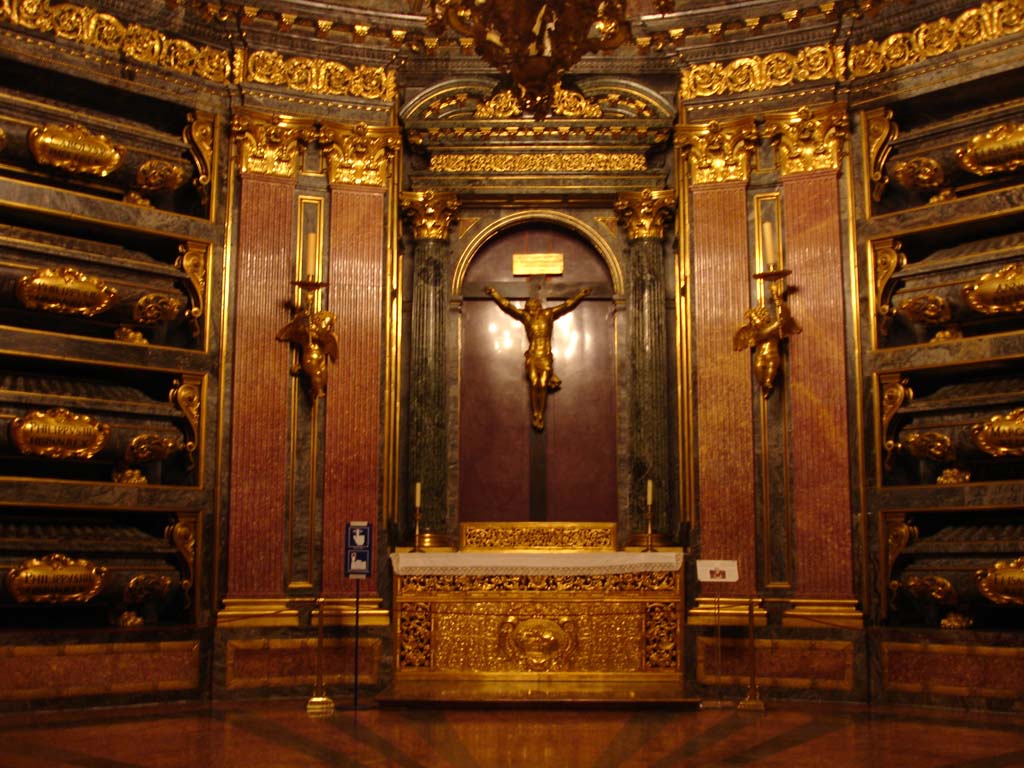
The Pantheon of the Kings was so interesting.  It consists of twenty-six marble sepulchers containing the remains of the kings and queens.  The sepulchers also contain the remains of royal consorts who were parents of monarchs.  The most recent remains in the sepulcher are those of King Alfonso XII, of his wife, as well as his son Juan, Count of Barcelona. Those of his and daughter-in-law Maria de las Mercedes (the mother of the current king, Juan Carlos I), lie at a prepared place called a pudridero, or the rotting room.
There are two pudrideros at El Escorial, one for the Pantheon of the Kings and the other for that of the Princes, which can only be visited by monks from the Monastery. In these rooms, the remains of the deceased are placed in a small leaden urn, which in turn will be placed in the marble sepulchers of the pantheon after the passage of fifty years, the estimated time necessary for the complete decomposition of the bodies.

The Valley of the Fallen located in the Sierra de Guadarrama 8 miles north of El Escorial. The complex was built between 1940 and 1958 and is a monument intended to commemorate all those who died on both sides during the Spanish Civil War (1936-1939). About 40,000 Nationalist and Republican soldiers are buried here. However, the Valley of the Fallen is inevitably associated with Francisco Franco (Spain's dictator from 1947-1975) since the late General is buried inside the basilica and he was the one who ordered its construction. The monument and its Catholic basilica remain controversial, particularly because 10% of the construction workforce were convicts, some of them prisoners.


Basilica Valley of the Fallen
Inside the basilica excavated in the rock.
Valley of the Fallen - Valle de los Caídos

One of the armed angels located inside the basilica

Franco's Tomb

The grave of Francisco Franco 

Friday, June 29, 2012

Spain: Madrid - Day 1-4

June 10th-13th, 2012

We left Calgary on a Sunday morning, connected in Amsterdam and arrived in Spain about 15 hours later.  We were tired but excited to be there so we went for a walk.  The Buen Retiro Park is one of the largest parks in Spain.  It happened to be quite close to where we were staying. The park belonged to the Spanish Monarchy until the late 19th century, when it became a public park.


In the park were many things to look at.  The Palacio de Cristal (Crystal Palace) was built in 1887 to exhibit flora and fauna from the Philippines.

In 1902, a national contest was held to design a monument for King Alfonso XII. The winner was the architect José Grases Riera, whose design consisted of a grand colonade alongside a pond in El Retiro, with several sculptures surrounding an equestrian statue of the king, with everything constructed in bronze and marble.

Amazing trees, shrubs and flowers!


The Entrance to the Park


Think these cars are parked a little bit too close? 

This is a picture of the 2 bedroom apartment building we stayed in. It was a "vacation by owner" rental so that we could stay in a non-touristy area.


The Plaza Mayor is Madrid's main square. It is located right in the centre of the city and was inaugurated in 1620 during Felipe III's reign, whose statue sits in the centre of the square. Public executions, crowning ceremonies, bullfights and Inquisition trials have all taken place right here.

The square is mostly surrounded by three-storey houses with balconies looking out onto the square and are still lived in.


The Palacio Real de Madrid (The Royal Palace of Madrid) is the official residence of the Spanish Royal Family in the city of Madrid, but it is only used for state ceremonies. King Juan Carlos and the Royal Family do not reside in the palace, choosing instead the more modest Palacio de la Zarzuela on the outskirts of Madrid.  The last monarch who lived continuously in the palace was Alfonso XIII.  The palace has 135,000 square metres (1,450,000 sq ft) of floorspace and contains 2800 rooms.  It is the largest palace in Europe by floor area.


This is the "Hop-on, Hop-off" bus tour.  It allowed us to get off at whatever site we wanted and then hop back on when we wanted.  Once on the bus, we were given headphones that allowed us to listen to the ongoing commentary which supplied tourist information. LOVED this bus and loved cruising Madrid (instead of walking :).


The Museo del Prado (The Prado Museum) is the main Spanish national art museum.  A special Rafael exhibit had just opened the day we were there.  No, not the Teenage Mutant Ninja Turtle.  We saw a Rembrandt (Karen's fav.), a lot of Velazquez and Goya. 
Apparently, the painting below is the museum's most famous by Deigo Velazquez. 

  File:Las Meninas, by Diego Velázquez, from Prado in Google Earth.jpg

File:Goya Maja ubrana2.jpg

Warren liked this painting - we saw it on posters and postcards everywhere.  Except Goya painted two versions of this painting.  The other one is a complete nude.  It was the nude we saw everywhere.  Nudity, as we would come to notice, is widely accepted in Spain...and art museums. 


This was my first meal in Madrid.  I had come to Spain expecting to not like the food - I had researched it.  This sandwich made me hopeful that I wouldn't starve.  This illusion did not last long. Here are some common foods in Spain:  Oxtail Stew, Gazpacho (was actually yummy), paella (Ok), croquettes (take any ground up food, bread it and fry it), tortillas (like an omelet often with potatoes in it - pretty good!), Iberian ham, lamb, and lots of fish and seafood.  My father-in-law enjoys seafood and even he could barely eat some of it.  Why do shrimp need to have their eyes on still when brought to the table and who wants to eat octopus??  The Spanish seem to think french fries are fancy food.  

Interesting fact - ham is a historically important food. The people of the Iberian Peninsula ate pork and ham in their diet, even in the Roman era. However, when the Moors conquered the Peninsula, because of their religious beliefs, eating pork was prohibited. After the Christians regained control they forced the Muslims and Jews to either convert to Christianity, go into exile or be executed. Eating ham could prove you were Christian!


This is the soccer stadium that is home to the Real Madrid team.  It can seat 80,000 people and has 70,000 season ticket holders!


The Cathedral Alamundens took 100 years to build.


I wasn't aware that people liked to be buried in Catholic Cathedrals.  Kings and Queens as well as anyone who donated large sums of money to build the Cathedrals could be buried in the buildings.  We saw a tomb/grave that was as recent as 2009.


An open air market where we had our first tapas experience. Tapas are basically appetizers that are eaten after 8pm.  The Spanish have coffee and a pastry (churros) for breakfast, eat their big meal at 2pm and then tapas or a light snack in the evening.  I found some really great things to eat in this market :) 


These women in the Market were promoting their show.  I don't think it was flamenco but some kind of dance/music show.  There was a little girl with the women (about 2 years old) and she was copying every move they made.  It was really cute.